
6 Distinctive Rare Creatures Captured by Trail Cameras
Trail cameras have changed wildlife storytelling by revealing animals that are rarely seen, sometimes almost never seen, by people in the field. They do more than produce dramatic images. In many cases, they confirm survival, extend known range, or provide the kind of proof conservationists need when a species has become nearly mythical in its absence.
Few trail-camera subjects are more distinctive than the saola, often called the “Asian unicorn.” Fauna & Flora notes that a camera trap in Vietnam’s Pu Mat National Park captured the first picture of a wild saola in 1998, an extraordinary moment for one of the world’s rarest large mammals. Later camera-trap work in central Vietnam produced another image in 2013, reminding conservationists that the species still lingered in the Annamite forests even as sightings remained vanishingly scarce. (Fauna & Flora)
Another remarkable rediscovery came from Vietnam with the silver-backed chevrotain, a tiny hoofed mammal so elusive that it had effectively slipped out of scientific view for decades. Re:wild reported that camera traps produced the first-ever photos and footage confirming the species’ rediscovery, turning what had seemed like a lost animal into a living conservation story again. Its small body, delicate legs, and fang-like teeth make it one of the strangest and most memorable animals ever brought back into public view by remote cameras. (Re:wild)
Big cats have also produced some of the most striking trail-camera moments, especially when the animal itself looks unusual even by jaguar standards. In Bolivia, Amazon Conservation said its camera traps photographed the first melanistic jaguar ever recorded in the country, a near-black individual whose coat made an already powerful predator look even more otherworldly. Because melanism is relatively uncommon in jaguars, the image stood out not just as a national first but as one of those trail-camera captures that instantly feels historic. (Amazon Conservation Association)
A different jaguar story unfolded much farther north in southern Arizona, where trail cameras have documented the species in the United States long after many people assumed it had effectively disappeared from that landscape. The Center for Biological Diversity reported that federally run trail cameras photographed a wild jaguar in the Huachuca Mountains in 2023, and later said a separate trail-camera video confirmed a new jaguar in southern Arizona in late 2023. These detections mattered because each one was a reminder that the borderlands still function as habitat for one of North America’s most iconic predators. (Center for Biological Diversity)
The wolverine may not have the fame of a jaguar, but trail cameras often make it look just as unforgettable. The Nature Conservancy described footage from the Owl Creek Mountains on the Wind River Indian Reservation in Wyoming showing a wolverine approaching a baited camera, adjusting the lens, and then rolling out of the frame. That kind of clip matters because wolverines are both wide-ranging and difficult to detect, so every confirmed camera-trap encounter carries unusual weight for understanding where they still persist. (Cool Green Science)
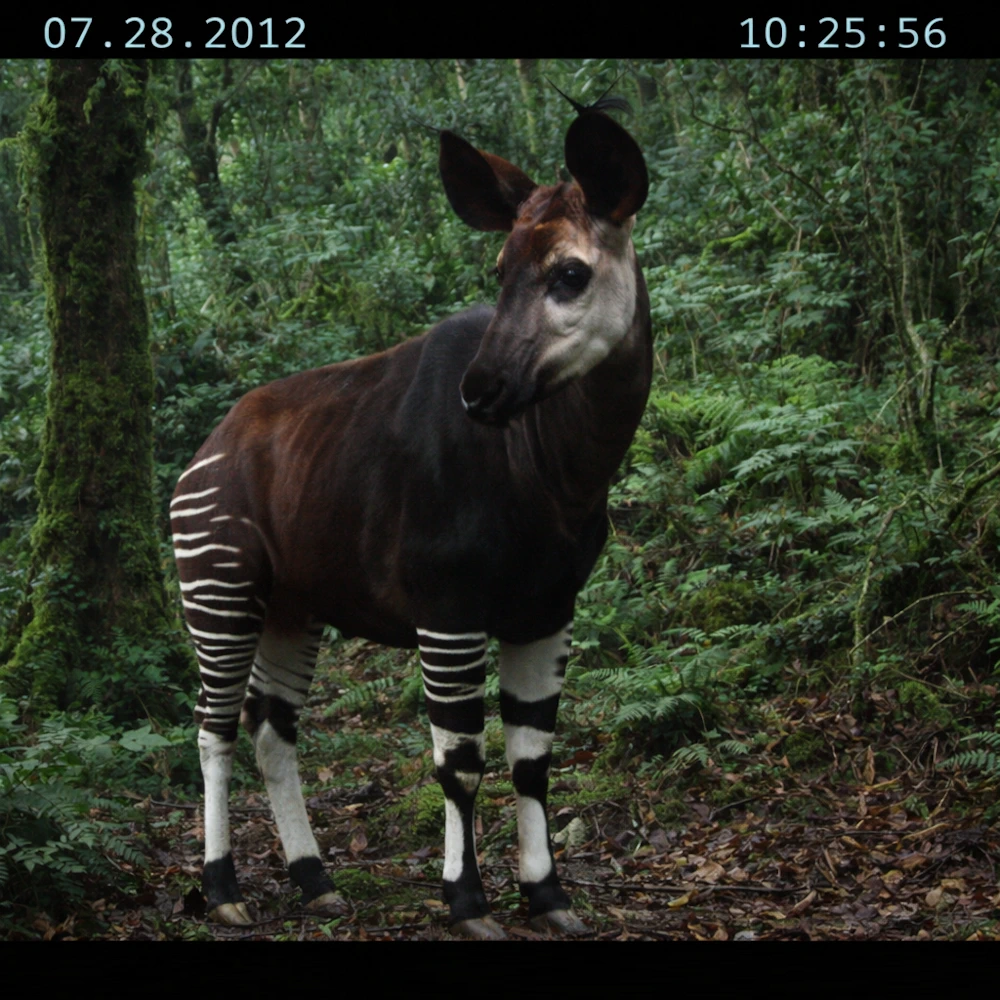
Then there is the okapi, an animal so visually improbable that it was once compared to a unicorn. The African Wildlife Foundation reported that camera traps set by the Zoological Society of London and the Congolese Institute for Nature Conservation captured the first photographs of okapi in the wild in Virunga National Park. With its giraffe-like build, velvet-dark coat, and zebra-striped legs, the okapi already looks as though it were assembled from several different species, which helps explain why those first camera-trap images were so captivating. (African Wildlife Foundation)
What links these six animals is not just rarity, but the way trail cameras changed their stories. For the saola and silver-backed chevrotain, cameras helped prove survival. For jaguars in Bolivia and Arizona, they documented both unusual individuals and unexpected persistence. For wolverines and okapi, they turned elusive presence into clear evidence. In every case, the camera did more than capture an image; it gave conservationists, and the wider public, a reason to believe that some of the natural world’s most distinctive animals are still out there.
Sources:
(Fauna & Flora)
(Re:wild)
(Amazon Conservation)
(Center for Biological Diversity)
(African Wildlife Foundation)
ExplainGenie is for informational purposes only. Best attempts are made to ensure reliability and timeliness of information. ExplainGenie does not sell off road vehicles or offer products or services of any kind for sale.