
Ditch Those Old Gutters: Showstopping New Styles That Drain Roofs Not Wallets
Modern gutters do more than quietly catch rain. Newer systems move water away from foundations more reliably, cut down on clearing clogs, and most importantly, look great on your home. The latest trends have turned what used to be a purely functional strip into a visible part of overall curb appeal and household long-term value.
Market research reflects how widely these upgrades are being adopted. A recent U.S. study values the gutters and downspouts market at around $8 billion, with demand projected to keep growing on the strength of residential improvement and repair work rather than just new construction. At the same time, the global gutter guards market is forecast to climb from about $910 million in 2024 to roughly $1.42 billion by 2030, as more households add covers and screens to minimize cleaning and reduce water-damage risk. (Strategic Market Research)
The list of options begins with seamless aluminum K-style gutters. Instead of short sections joined every few feet, seamless gutters are formed on-site from a continuous coil of metal using a machine mounted on a service truck, which means there are no mid-run seams to flex, leak, or catch debris. Installers note that these systems are custom-cut to match each roofline and can often be installed in a single day, while the K-style profile provides excellent durability and water-carrying capacity in a relatively lightweight aluminum channel. (Brothers Gutters)
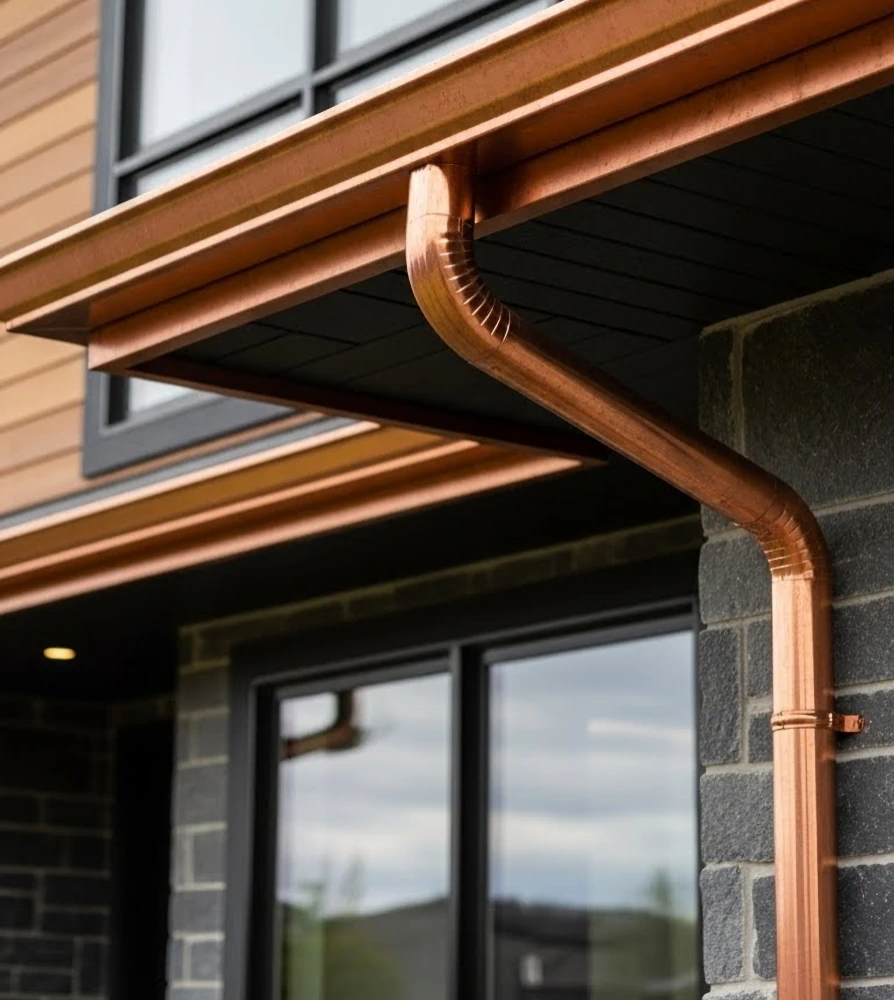
In more traditional or high-end applications, half-round and copper gutters offer a different blend of performance and style. Half-round gutters use a smooth U-shaped profile that encourages water to flow freely and leaves fewer corners where debris and standing water can collect, which in turn can reduce corrosion and clogging compared with angular profiles. When that shape is executed in copper, the system adds long-term durability and a patina that evolves from bright metallic to rich brown and soft green over decades, turning the gutters into a deliberate architectural accent as well as a long-lasting rainwater channel. (This Old House)
Some households choose to combine new gutters and gutter protection in a single step by installing one-piece hooded systems such as LeafGuard. Instead of hanging standard open troughs and then adding guards later, this style integrates a continuous aluminum gutter with a built-in curved hood that uses liquid adhesion to pull water into the channel while directing leaves and debris over the edge. The manufacturer highlights that its seamless, one-piece construction is engineered to handle heavy rainfall and reduce clogging, with the goal of removing routine gutter cleaning from the maintenance list while preserving the fascia and foundation from overflow. (LeafGuard)
Where existing gutters are structurally sound, micro-mesh gutter guard systems like LeafFilter offer another path to modernization. LeafFilter is a professionally installed stainless-steel micro-mesh cover that mounts on top of current gutters, with pores fine enough to keep out shingle grit, pine needles, and other small debris while allowing water to pass through. The company positions the system as a permanent solution to clogged gutters that uses corrosion-resistant materials and is tailored to the roofline, appealing to homeowners who want to upgrade performance without replacing the underlying metal runs. (LeafFilter)
Surface-tension gutter covers such as Gutter Helmet provide a different style of protection. Instead of mesh, these systems use a rigid, curved panel that extends over the open gutter, relying on the tendency of water to follow the panel’s ribbed surface and curl into a slot along the front edge. Leaves and larger debris are designed to fall off the rounded nose while water continues into the gutter channel, which helps keep the system flowing even in heavy rain and reduces the frequency of manual cleaning. (Gutter Helmet)
Do-it-yourself–friendly stainless steel micro-mesh products, such as Gutterglove kits sold through major home centers, extend similar technology to projects where contractors or homeowners prefer to work from boxed components. These guards typically use 4-foot aluminum frames topped with fine stainless mesh that fasten to existing K-style gutters with screws or clips, providing a continuous screen that blocks leaves and roof grit. Installation is designed to be straightforward with common tools, allowing many homes to add high-performance gutter protection during a single weekend or as part of a broader exterior refresh. (Gutterglove)
Independent experts and consumer guides increasingly point to gutter guards as a practical way to reduce maintenance and prevent hidden damage. Analyses from home improvement media note that well-designed guards can cut the frequency of gutter cleaning by as much as 70 percent, limit overflow that leads to fascia rot and basement leaks, and provide long service lives when installed correctly. In neighborhoods with mature trees or frequent storms, these benefits help explain why gutter protection has shifted from a niche accessory to a common line-item in exterior renovation budgets.
The installation process has also become easier and more predictable, which encourages upgrades when older systems start to fail. Seamless gutter companies rely on portable forming machines to cut custom lengths on-site, while many residential projects—from tear-off to new gutters and guards—can be completed in a single day, depending on the size and complexity of the house. Industry timelines describe typical professional installations as taking only a few hours to a day for most homes, turning gutter replacement from a disruptive construction job into a manageable, scheduled service call that delivers immediate improvements in drainage, appearance, and peace of mind.
ExplainGenie is for informational purposes only. Best attempts are made to ensure reliability and timeliness of information. ExplainGenie does not offer products or services of any kind for sale.