
Prefab Homes Provide Cost-Effective Housing
As rising interest rates make home-buying increasingly difficult, many Americans are looking at alternative home solutions. Numerous options fit the bill, including prefab homes. Prefab homes are built in factories, shipped in sections, and assembled on‑site in a fraction of the time and cost required for conventional construction. Let's take a look at top prefab home and floor‑plan options.
US Modular, based in California, specializes in fully finished modules that roll off the production line with plumbing, wiring, and interiors already in place. Its offerings run from the 650‑square‑foot Pioneer, a one‑bedroom starter ideal for infill lots, to the two‑story Mountaineer Deluxe, whose three‑bedroom layouts exceed 2,800 square feet. Between those poles sits the Alpine—up to 1,680 square feet with a vaulted great room and dedicated primary suite—and the Timberline, a series of expansive ranch plans that stretch past 2,300 square feet. Because each model ships as code‑compliant modules, build times after permits can be measured in weeks rather than months, and buyers can tailor finishes or add wrap‑around porches before the first wall panel leaves the factory.
Stillwater Dwellings approaches prefab from a high‑design perspective, blending mid‑century modern lines with a patented “spine‑and‑wing” panel system. Its Signature Series catalog lists more than a dozen plans, among them the sd‑153—a 2,270‑square‑foot, three‑bedroom composition of glass and cedar wings anchored by a central gallery hall—and the sd‑161, a single‑story plan that expands to roughly 2,850 square feet with up to four bedrooms. All Stillwater homes arrive as precisely milled panels that bolt together on‑site; finish packages specify everything down to the brand of address numbers, ensuring the flat roofs, deep eaves, and floor‑to‑ceiling glazing retain a unified architectural language.
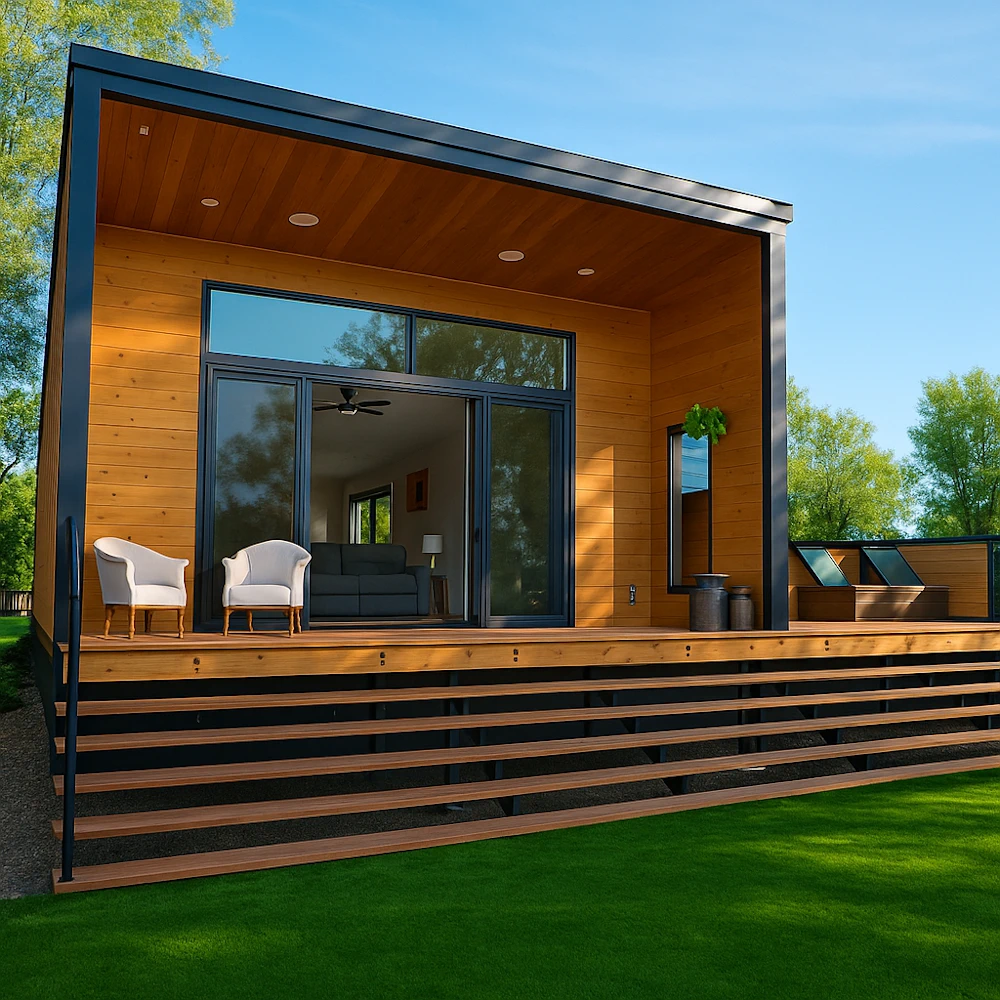
DC Structures trades modern minimalism for heavy‑timber drama, supplying nationwide kits that evoke classic barns yet live like contemporary residences. The 2,000‑square‑foot Fremont barn‑home kit serves singles or small families with two bedrooms, an office, and double‑height living space framed in Douglas‑fir posts and beams. Step up to the Concordia and square footage rises to 2,718; three bedrooms, a den, and an open loft orbit a vaulted great room overlooked by exposed trusses. Even the family‑oriented Hawthorne, at just over 2,300 square feet, includes a wrap‑around porch for indoor‑outdoor gatherings. Each kit ships with pre‑cut timbers, engineered blueprints, and detailed hardware packages, allowing local crews to raise the shell quickly before owners finish the interior as budgets allow.
Impresa Modular offers a vast digital library—more than 1,000 floor plans—that can ship to most U.S. ZIP codes. At the compact end, the Fenwick park‑style cottage measures 810 square feet yet fits two bedrooms and a full bath beneath its simple gable roof. A mid‑range option like the Nova 9A stretches to 1,056 square feet and adds a wide covered porch to its three‑bedroom layout. Families needing more elbow room gravitate to the Laurel Bay B ranch, a 1,921‑square‑foot plan with a split‑bedroom configuration, or to the Model VI chalet, whose 3,465 square feet support grand cathedral ceilings and walls of glass aimed at mountain or lake views. Because Impresa works with regional factories, each plan can be re‑engineered for local snow loads, wind ratings, and energy codes.
Together, these companies reveal how “prefab” now describes a spectrum rather than a single construction method. A buyer might choose US Modular for a turnkey house that meets California’s strict seismic code, select Stillwater for a minimalist retreat that captures vineyard views through sliding glass corners, commission DC Structures for a timber‑rich barn‑dominium with workshop bays, or browse Impresa’s online catalog to find a ranch plan that ships to a rural lot in days. What unites them is off‑site precision: walls arrive square, mechanical chases are pre‑routed, and finishes are installed in climate‑controlled shops, shrinking both construction timelines and financing costs.
Prefab’s final advantage lies in flexibility. Modules can extend, stack, or pivot around outdoor courtyards as families grow; panelized shells accept deep insulation, triple‑pane windows, and rooftop solar arrays without structural tweaks; and heavy‑timber frames allow open interiors that would demand costly steel in conventional builds. As zoning boards warm to accessory dwelling units and remote workers seek land beyond city limits, the appeal of a home that shows up 80 percent complete—and whose craftsmanship rivals site‑built counterparts—continues to rise. Whether your dream is a minimalist glass pavilion, a vaulted timber lodge, or a budget‑friendly ranch, the prefab industry now offers a plan, a factory line, and a delivery truck ready to make it real.
ExplainGenie is for informational purposes only. Best attempts are made to ensure reliability and timeliness of information. ExplainGenie does not sell homes or offer products or services of any kind for sale.