
The Complete 2026 Rolex Watch Guide
Rolex has spent more than a century refining the deceptively simple idea that a wrist‑watch should be both rugged and refined. Hans Wilsdorf’s first Oyster of 1926 proved a timepiece could be watertight; ever since, the Geneva manufacture has pursued “perpetual excellence." Within that ethos, a handful of models have become shorthand for entire categories of watchmaking; here's a look at which are the top consider this year.
Rolex unveiled one of its most significant new collections in over a decade with the new Oyster Perpetual Land-Dweller, a totally new line featuring an integrated bracelet, a laser-etched honeycomb dial, and the advanced calibre 7135 movement that signals a fresh design direction for the brand. Rolex also recently refreshed existing mainstays, introducing ceramic-dial variants of the GMT-Master II—including a white-gold case with a green ceramic dial—and a suite of new pastel and vibrant faces across the Oyster Perpetual line. Other highlights included the gold-braced Perpetual 1908, dramatic red-ombré-dial Datejust 31 models, and updated dials on icons like the Cosmograph Daytona and Sky-Dweller, all of which continue Rolex’s blend of refined aesthetics and technical excellence. These additions reflect Rolex’s dual strategy of expanding its heritage with bold new executions while refreshing core classics with intriguing material and color updates. (rolex.com)
The new Land-Dweller is built around an integrated bracelet—an approach Rolex has only flirted with in past experiments such as the late-’60s Rolex Quartz and the ’70s Oysterquartz era, but never sustained in its modern mechanical lineup. Here, case and bracelet flow as a single silhouette, giving the watch a sleek, continuous profile that sits closer to the “sports-elegant” category than to the traditional three-piece Oyster case with a separate bracelet. It looks like Rolex remembering an old idea and finally deciding the time is right. (Rolex)
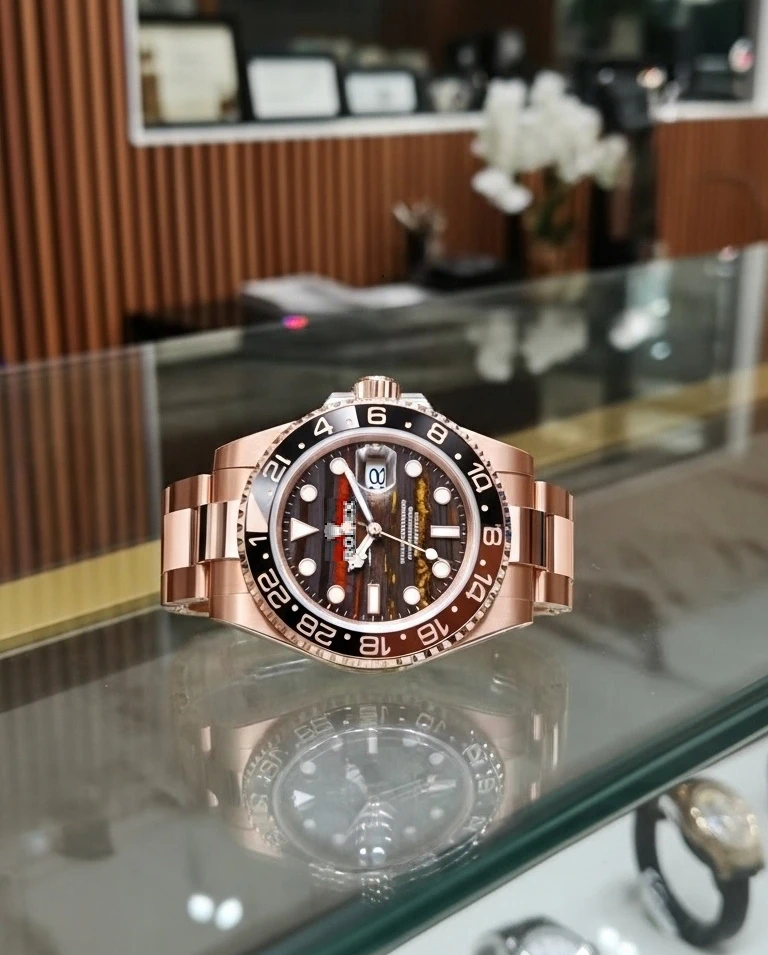
The new Tiger Iron colored GMT-II is described as a semi-precious gemstone formed from a natural blend of tiger’s eye, red jasper, and black hematite, it creates layered, earthy bands of gold, red, and deep grey that shift with the light. Each slice of stone is unique, so no two watches present exactly the same pattern, which adds a degree of individuality unusual in a regular-production GMT-Master II and reinforces the piece’s position as an exclusive 2025 release. (Rolex)
The Submariner is the archetype of the modern dive watch. When it debuted in 1953 it was the first wrist‑watch guaranteed waterproof to 100 metres; today’s versions extend that margin to 300 metres while adding a unidirectional 60‑minute bezel, Chromalight luminous display and the Triplock‑sealed Oyster case, all evolved to survive the punishing pressure of deep water. Rolex’s engineers have never abandoned the Submariner’s original brief—clarity, robustness and instantaneous legibility—but they have quietly modernised it with 904 L Oystersteel, proprietary Cerachrom inserts and calibre 3230/3235 movements, making what began as an instrument a universally wearable symbol of adventure.
Where the Submariner conquered the oceans, the Cosmograph Daytona was built for asphalt. Introduced in the 1960s for endurance racers on the Florida speedway that lends the watch its name, the Daytona pairs a high‑performance self‑winding chronograph with a tachymetric scale capable of reading average speeds up to 400 units per hour. Its trio of snailed counters, screw‑down pushers and Cerachrom or precious‑metal bezel turn the Oyster case into a pit‑lane timing console, while the latest calibre 4131 further trims the movement architecture for reliability under shock. Decades of incremental refinement mean the Daytona still does exactly what it was born to do—only faster and more accurately.
If the Daytona measures speed and the Submariner measures immersion time, the Datejust measures daily life. Launched in 1945 to mark Rolex’s 40th anniversary, it was the first self‑winding, waterproof chronometer to place the date in a dial aperture; eight years later Rolex magnified that indication with the Cyclops lens, cementing a design now recognised at a glance Rolex. Offered from 28 mm to 41 mm, in Oystersteel, Rolesor or full gold and on Oyster or Jubilee bracelets, the Datejust’s genius lies in its adaptability: the same architecture can read as formal with a fluted bezel and diamond markers, or sporty with a smooth bezel and bright blue sun‑ray dial Rolex. What never changes is the dependable automatic calibre and the promise that the date will jump crisply at midnight, day after day.
Taken together, these models illustrate the breadth of Rolex’s approach. Whether timing a decompression stop, a Le Mans pit‑stop, a transatlantic flight, a turning of the calendar page, or simply the quiet seconds of an ordinary afternoon, each watch is built on the same foundational innovations yet tailored to a distinct human pursuit. That continuity of purpose—refining function until it attains elegance—explains why a single crown on a dial continues to signify durability, precision and a certain understated prestige, generation after generation.
ExplainGenie is for informational purposes only. Best attempts are made to ensure reliability and timeliness of information. ExplainGenie does not sell watches or offer products or services of any kind for sale.