
Why You Might Want To Live In A 308 Square Foot ADU
Prefab accessory dwelling units ("ADUs"), have moved from niche experiment to mainstream housing, driven by rapid construction timelines, predictable pricing, and factory-built designs. Typical prefab ADUs now span 300 to 1,200 square feet, with many complete project costs in the ballpark of $80,000 to $250,000 depending on size, finishes, and site. Here's some of the best options right now.
One of the better-known players is Studio Shed, whose Summit Series covers a wide range of ADU footprints in a clean, modern style. The company describes the Summit line as its primary ADU solution, with sizes from roughly 308 to 1,000 square feet and starting prices around the high-$30,000s to low-$40,000s for the shell and permit plans, with interior build-out, assembly, and site work added on top. The Aspect line sits alongside Summit at 576 or 864 square feet and starts at about $139,950 plus assembly, but Summit remains the more flexible, scalable option for homeowners who want a detached small home that can be tuned from compact studio to larger two-bedroom layouts. (Studio Shed)
Within the Summit models, Studio Shed publishes clear square footage and base pricing that illustrate how prefab ADUs scale. The Summit 364 is a 364-square-foot studio ADU with a starting shell price around $87,200, while the Summit 476 grows that to 476 square feet and one bedroom from about $111,200. Larger units such as the Summit 684 (684 square feet, one bedroom) and Summit 1000 (1,000 square feet, two bedrooms) start in the mid-$120,000s and mid-$160,000s respectively for the building kit, with discounts sometimes advertised off earlier higher list prices. These figures do not include assembly or local work like foundations and utilities, but they give a transparent baseline for comparing Summit to other prefab options. (Studio Shed)
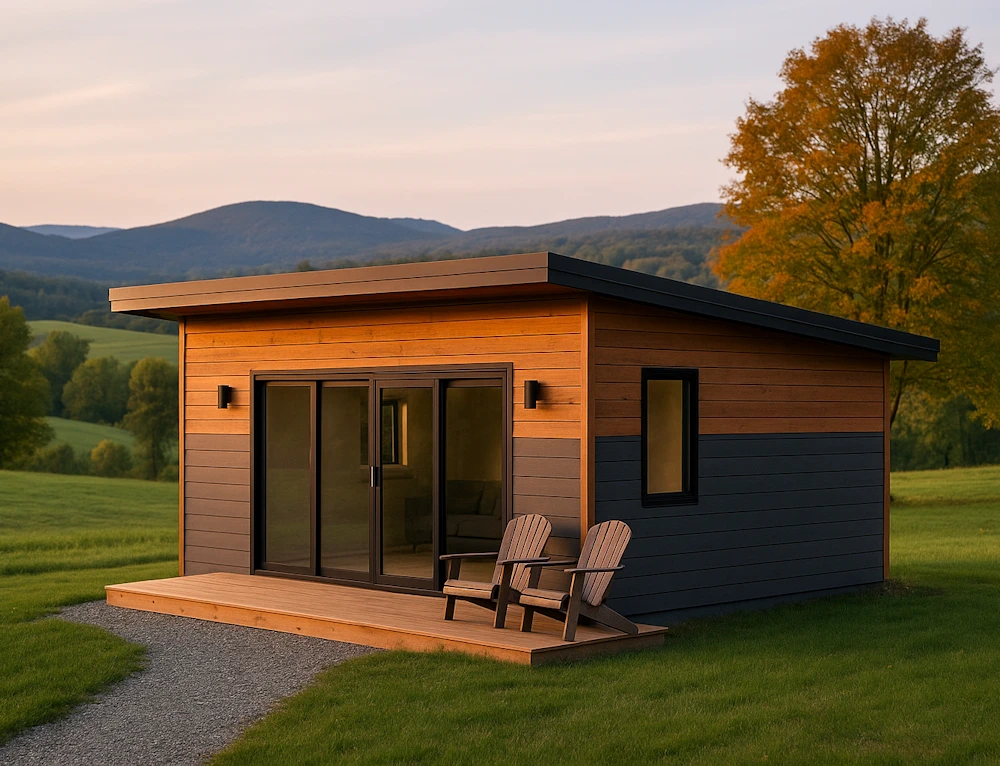
Smaller Summit Series footprints like the Summit 308 and Summit 476 show how much function can fit into a compact prefab shell. The Summit 308, roughly a 14-by-22-foot layout, is marketed as a complete studio ADU with a full kitchen and full bathroom in about 308 square feet, designed to serve as a standalone tiny home, guest house, or long-term rental in a backyard. The Summit 476 pushes that idea toward a one-bedroom plan, pairing 476 square feet with a “Lifestyle+” bathroom and a medium kitchen package, including fixtures, shower, water heater, HVAC mini-split, and finished interior surfaces as part of a turn-key interior upgrade bundled with the shell. (Studio Shed)
Studio Shed also gives a sense of all-in budget planning by publishing example cost breakdowns: for a 400-square-foot Summit ADU, the company cites product plus assembly at around $250 per square foot, before local site work and permits, and notes that its Summit Series ADUs are typically more affordable and faster to complete than custom design-build additions. That framing—transparent shell price plus illustrative per-square-foot turnkey numbers—has made the brand a common benchmark when homeowners and consultants compare prefab ADU options in online guides and cost calculators. (Studio Shed)
On the other side of the prefabrication spectrum, PrefabADU focuses on panelized kits aimed at affordability and code-compliant small homes. The company markets its products as an “affordable housing solution” that lets property owners choose between using a full general contractor, acting as an owner-builder who hires subs, or tackling portions of the build in a more hands-on way, all based on standardized kits and plan sets. Its catalog is organized into Micro, Mini, Suite, and Villa units, covering everything from very compact 150-square-foot studios to 1,000-square-foot two-bedroom layouts. (PrefabADU) (prefabADU Backyard Home Experts)
The Micro Series is where PrefabADU stakes out some of the smallest true ADUs on the market, rather than RV-code tiny homes. The Micro 150 offers about 150 square feet in a 12-by-12-foot footprint with one bed, one bath, and a kitchenette, built to residential building code and typically completed in roughly 90 days from foundation to final inspection, a pace that the company highlights as a key advantage. Micro 200 and Micro 250 plans expand the same concept up to 200 and 250 square feet, respectively, giving homeowners a way to add a legal, insurable small unit for guests, rentals, or extended family on lots that cannot accommodate larger structures. (PrefabADU) (prefabADU Backyard Home Experts)
For those who want more space while staying relatively compact, PrefabADU’s Mini Units in the 250- to 399-square-foot band represent its most popular range. Models such as The Becky at 288 square feet (roughly 14 by 24 feet) and The Elisabeth at 300 square feet are set up as one-bedroom, one-bath homes with a kitchenette, and are marketed as feeling larger than their footprints suggest, especially on tight urban lots where zoning encourages smaller ADUs. Independent pricing analysis from prefab reviewers has estimated all-in Becky costs around $116,640 for a 288-square-foot unit, with other Mini and larger models climbing from there as square footage and program increase. (PrefabADU)
Beyond Micro and Mini sizes, PrefabADU also offers Suite and Villa plans that push into the 600- to 1,000-square-foot range with one- and two-bedroom configurations, keeping the same panelized methodology but scaling up to more traditional small-house proportions. External cost breakdowns suggest that the largest Villa-type models, such as a 1,000-square-foot two-bedroom, can run into the mid-$300,000s all-in, including construction and standard finishes, reinforcing the broader pattern that larger ADUs approach the cost of full houses even when prefabricated, while still benefiting from factory efficiencies and repeatable design. (Prefab Review)
Taken together, these examples show that prefab ADUs are less a single product type than a spectrum: compact shell kits such as Studio Shed’s smaller Summit models, mid-size turnkey cottages like PrefabADU’s Becky or Elisabeth, and higher-end modular homes from brands like Nest or Villa. Across that spectrum, the common threads are faster timelines, standardized plans vetted for code compliance, and more predictable budgets powered by factory production. For homeowners and families looking to add flexible space for relatives, rental income, or work-from-home life without embarking on a fully custom build, prefab ADUs have become a practical path to backyard housing, with square footage and pricing that can be matched to both lot size and financial goals.
ExplainGenie is for informational purposes only. Best attempts are made to ensure reliability and timeliness of information. ExplainGenie does not sell ADUs or offer products or services of any kind for sale.